

Six primary reports released between January and October 2026 put fresh numbers on zero trust. This page gathers zero trust statistics from Zscaler, Cybersecurity Insiders, Open Systems, Verizon, IBM and Microsoft.
It covers how far rollouts have gone, what blocks them, where VPN access still leaks, which entry points attackers favor, what breaches cost and the forecasts published for 2028.
Zero Trust Statistics 2026 at a Glance
How Many Organizations Have Fully Adopted Zero Trust in 2026?
Intent sits close to its ceiling. Zscaler’s ThreatLabz 2026 VPN Risk Report found 84% of organizations planning or transitioning to zero trust, up from 78% two years earlier.
Source: Zscaler ThreatLabz 2026 VPN Risk Report, survey of 822 IT and cybersecurity professionals, March 2026
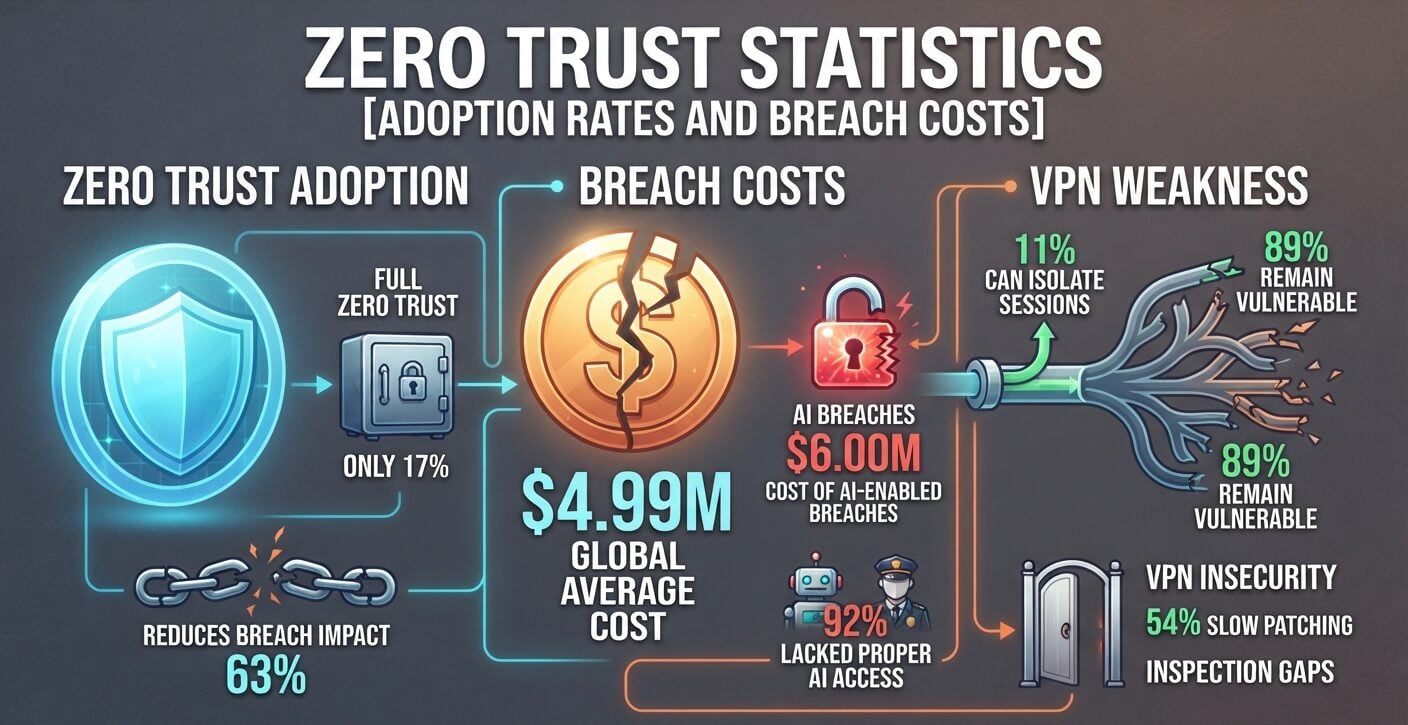
Completion tells a different story. In the Cybersecurity Insiders 2026 Zero Trust Report, sponsored by HPE, 82% called Universal ZTNA essential but 17% had fully implemented it.
Another 46% reported partial deployment and 24% were still planning. Respondents rated their zero trust effectiveness at 6 out of 10 on average.
Source: Cybersecurity Insiders, 2026 Zero Trust Report, 851 respondents surveyed in late 2025, published January 2026
The report sizes the distance between conviction and execution at 65 points.
US and UK Organizations Stuck in the “Middle State”
Open Systems ran a separate poll with Cybersecurity Insiders covering 505 IT and security leaders in the US and UK. Results came out on January 27, 2026.
| Finding | Share of respondents |
|---|---|
| Report a fully integrated zero trust architecture | 8-9% |
| Still rely only on traditional WAN and VPN | 13-14% |
| Cite lack of end-to-end visibility as biggest operational challenge | 67-68% |
Source: Open Systems, 2026 SASE and Zero Trust Survey (US and UK findings), January 2026
Hybrid environments are now the default operating model, according to the survey. The budgets behind that shift appear in this breakdown of digital transformation spending by industry.
Nearly half of respondents report significant difficulty running VPN and ZTNA in parallel. For operations, 78% of US and 85% of UK respondents prefer a co-managed or fully managed SASE model.
Source: Open Systems, 2026 SASE and Zero Trust Survey, January 2026
Tool Sprawl, Not Budget, Tops the Zero Trust Barrier List
| Barrier or condition | Share of respondents |
|---|---|
| Name tool and vendor sprawl as the biggest barrier | 26% |
| Manage secure access policy across more than two systems | 78% |
| Operate access policy from one unified platform | 17% |
| Say excessive access is very or moderately widespread | 52% |
Source: Cybersecurity Insiders, 2026 Zero Trust Report, January 2026
Sprawl ranked ahead of budget, skills and legacy systems. The report names fragmentation, not funding, as the reason progress stays slow.
Least privilege erodes at scale. Employee over-privilege was the most cited source of unauthorized access, at 56%.
SaaS and cloud applications came second at 48%, which the report ties to adoption outpacing governance. For the size of that adoption, see these SaaS market statistics.
Respondents could pick more than one source, so the four shares overlap and should not be added together.
Source: Cybersecurity Insiders, 2026 Zero Trust Report, January 2026
Starting Points and Motives for Zero Trust Programs
No single route dominates. Replacing VPN with ZTNA is the most common first step, chosen by 30% of organizations.
Platform-first consolidation follows at 26%. Identity-first paths account for 17%, network-first for 14% and cloud-first for 10%.
Source: Cybersecurity Insiders, 2026 Zero Trust Report, January 2026
Why Organizations Pursue Zero Trust
| Outcome driving zero trust and SASE strategy | Share of respondents |
|---|---|
| Reduced security risk and breach impact | 63% |
| Greater operational agility | 41% |
| Lower cost through tool and vendor consolidation | 33% |
Source: Cybersecurity Insiders, 2026 Zero Trust Report, January 2026
Consolidation also shapes architecture choices. 34% favor a single-vendor SASE platform and 29% a hybrid platform model.
Asked what would most speed progress, 29% picked unified platform adoption. Executive sponsorship (17%) and skills investment (15%) trailed.
Source: Cybersecurity Insiders, 2026 Zero Trust Report, January 2026
Only 11% Can Contain a Hijacked VPN Session
Zscaler surveyed 822 IT and cybersecurity professionals for its 2026 VPN Risk Report. Just 11% can restrict a compromised session to a single application.
Source: Zscaler ThreatLabz 2026 VPN Risk Report, March 2026
In most organizations, Zscaler notes, a stolen credential can become a path to broader internal access.
| VPN risk finding | Share of respondents |
|---|---|
| Take a week or more to patch critical VPN vulnerabilities | 54% |
| Rank patching as their top operational challenge | 56% |
| Inspect 0% of encrypted VPN traffic | 1 in 3 |
| Can inspect virtually all encrypted VPN traffic | 8% |
| Say users bypass VPN controls to reach apps faster | 63% |
| Report limited or no visibility into AI threats moving over VPN | 70% |
| Encountered AI-enabled attacks in the last 12 months | 61% |
Source: Zscaler ThreatLabz 2026 VPN Risk Report, March 2026
Attacker speed is the top fear, cited by 79% of respondents. Only 24% have deployed AI-powered monitoring.
Users route around friction. Slow connections top the complaint list at 29%, followed by inconsistent device behavior (23%) and frequent disconnections (19%).
Source: Zscaler ThreatLabz 2026 VPN Risk Report, March 2026
Which Breach Entry Points Grew in the 2026 DBIR and MDDR?
Software flaws now lead. Verizon’s 2026 Data Breach Investigations Report found 31% of breaches began with vulnerability exploitation.
That is the first time in 19 years of the DBIR that exploitation passed stolen credentials as the top entry point. Third parties were involved in 48% of breaches, up 60%.
Source: Verizon 2026 Data Breach Investigations Report, released May 19, 2026, based on 2025 data
Mobile social engineering through fake texts and voice calls succeeded 40% more often than email phishing. That matters given how smartphone use spreads across age groups.
Frequent employee use of AI tools jumped from 15% to 45% in one year. Verizon ranks shadow AI, meaning unapproved AI chat and assistant tools at work, as the third most common non-malicious data leakage activity.
Source: Verizon 2026 Data Breach Investigations Report, May 2026
What Microsoft’s Telemetry Shows
Microsoft released its Digital Defense Report 2026 in October, covering July 2025 to June 2026. Phishing made up 23% of observed intrusions, up from 7% in 2025.
Footholds spread fast. Among intrusions that used valid accounts, 52.2% led to further credential theft.
Government agencies and services drew 27% of observed threat activity, up from 17%. That made government the most affected sector.
Source: Microsoft Digital Defense Report 2026, July 2025 to June 2026
Zero Trust Statistics on Breach Costs: IBM’s $4.99 Million Record
Breaches got more expensive again. IBM’s 2026 Cost of a Data Breach Report puts the global average at $4.99 million, up 12% and the highest on record.
Ponemon Institute ran the study for IBM, covering breaches at 602 organizations between March 2025 and February 2026.
Source: IBM Cost of a Data Breach Report 2026, published July 29, 2026
The 2025 edition was the dip, at $4.44 million and the first decline in five years. The 2024 edition reported $4.88 million, up from $4.45 million in 2023.
Source: IBM Cost of a Data Breach Reports, 2024 and 2025 editions
| Breach category (2026 report) | Average breach cost (USD) |
|---|---|
| Global average, all breaches | $4.99 million |
| AI-enabled malicious breaches | $6 million |
| Model inversion attacks on AI | $6.07 million |
| Prompt injection attacks on AI | $5.89 million |
| Financial services | $6.3 million |
| Energy | $5.2 million |
Source: IBM Cost of a Data Breach Report 2026, July 2026
One in four malicious breaches was AI-enabled, a 56% increase over the prior year. Financial services and energy saw the highest concentration of AI-driven attacks.
AI Access Controls: 2025 vs 2026
Access gaps show up most in AI incidents. More than 20% of organizations reported a breach targeting AI models or applications in 2026, and 92% of those lacked proper AI access controls.
IBM’s 2025 report put the same two figures at 13% and 97%.
Just 40% of organizations use access controls on AI models and data. Fewer than half are actively securing non-human identities such as AI agents.
Encryption lags as well. 37% of breached organizations encrypt sensitive data both at rest and in transit.
Automation pays back. Extensive use of AI and automation in security cut breach costs by $1.93 million versus organizations using none.
Source: IBM Cost of a Data Breach Reports 2025 and 2026, July 2025 and July 2026
What Do Gartner and Microsoft Project After 2026?
Gartner expects zero trust to reach data governance. By 2028, 50% of organizations will adopt a zero-trust posture for data governance as unverified AI-generated data spreads, the firm forecast.
Source: Gartner press release, January 21, 2026
Microsoft projects publicly disclosed CVEs will hit a record 72,000 in 2026. It also reports that the time from discovery in the wild to weaponization can fall well below 24 hours.
Source: Microsoft Digital Defense Report 2026, October 2026
IBM tracked spending intent separately. In a follow-on study of 456 organizations in May 2026, 85% said they plan to raise security spending after learning of frontier AI cyber capabilities.
Source: IBM and Ponemon Institute follow-on research, May 2026
FAQs
What percentage of organizations use zero trust in 2026?
Most have started, few have finished. Zscaler’s March 2026 survey found 84% planning or transitioning, while 17% had fully implemented Universal ZTNA in the Cybersecurity Insiders report published January 2026.
What is the average cost of a data breach in 2026?
IBM puts it at $4.99 million globally, a 12% rise and a record. The 2026 report covers 602 organizations breached between March 2025 and February 2026.
Is ZTNA replacing VPN?
Gradually. VPN replacement with ZTNA is the most common zero trust starting point at 30%, and only 13-14% of US and UK organizations still rely solely on WAN and VPN.
What is the biggest barrier to zero trust?
Tool and vendor sprawl. 26% named it their top barrier, ahead of budget and legacy technology, and 78% manage access policy across more than two systems (Cybersecurity Insiders, 2026).
Is zero trust just a buzzword, as some Reddit threads argue?
Survey data points to an execution problem, not an empty concept. Respondents rate their zero trust effectiveness at 6 out of 10, and 82% call Universal ZTNA essential while 17% have fully implemented it.
Sources
https://www.zscaler.com/blogs/company-news/ai-machine-speed-breaking-vpn-security
https://www.verizon.com/about/news/breach-industry-wide-dbir-finds
