

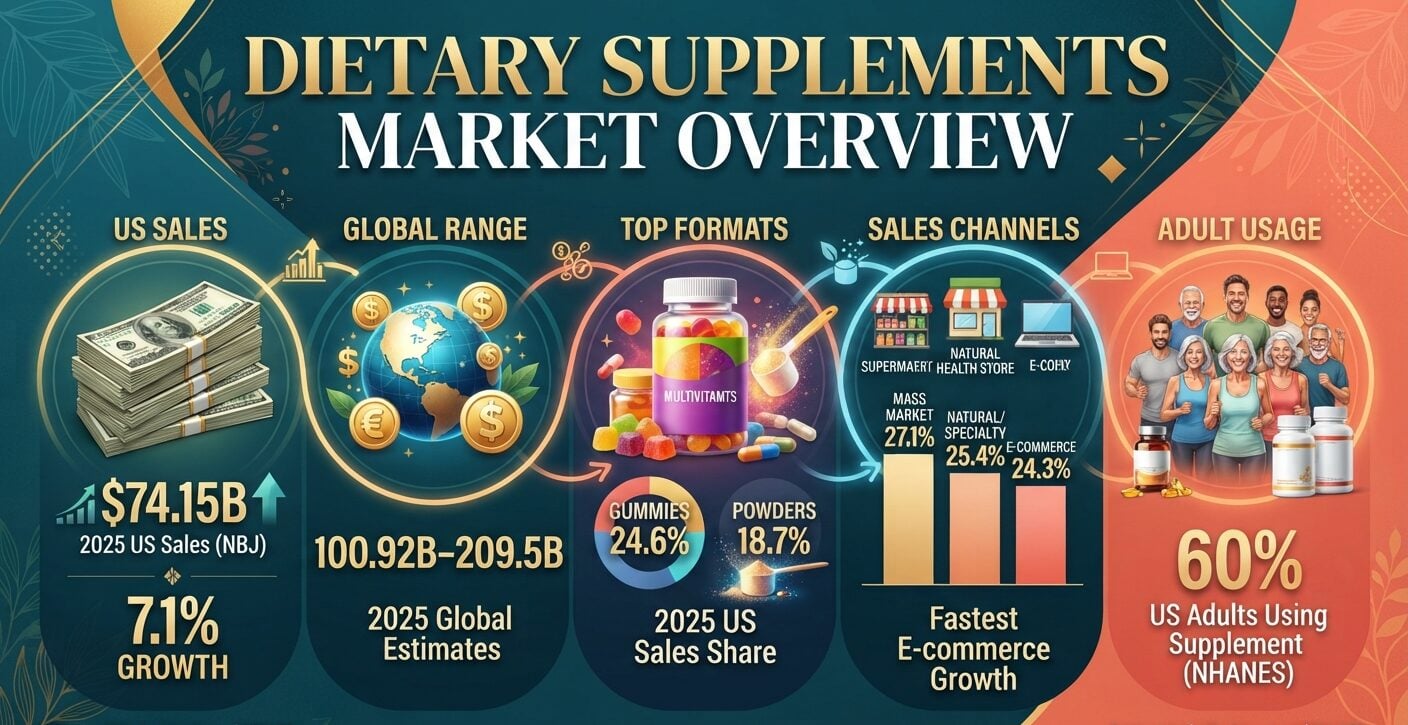
US dietary supplement sales reached $74.15 billion in 2025, while four research firms place the global market for the same year between $100.92 billion and $209.5 billion. These dietary supplements market statistics cover global and US sales, category, format and channel shares, NHANES usage data and FY2025 company revenue, each tied to its source and period.
Dietary Supplements Market Statistics
Global Dietary Supplements Market Size Estimates For 2025 And Beyond
Four research firms value the 2025 global market between $100.92 billion and $209.5 billion. Each total reflects that firm’s own product scope, so the figures are not interchangeable.
Grand View Research estimated $209.5 billion for 2025 in a March 2026 release. It forecasts $393.56 billion by 2033, a CAGR of 8.1% for 2026–2033.
Source: Grand View Research, March 2026 release
Precedence Research values the market at $203.42 billion in 2025 and $218.88 billion in 2026. Its forecast reaches $430.39 billion by 2035 at a 7.78% CAGR.
Source: Precedence Research, 2025 base year, 2026–2035 forecast
MarketsandMarkets projects growth from $192.60 billion in 2025 to $278.41 billion by 2030, a 7.6% CAGR.
Source: MarketsandMarkets, 2025–2030 forecast
Fortune Business Insights reports the lowest base: $100.92 billion in 2025, $109.20 billion in 2026 and $219.31 billion by 2034. Its forecast CAGR is 9.11%.
Source: Fortune Business Insights, report updated August 2026
Published growth rates sit between 7.6% and 9.11%, a tighter band than the dollar values. Supplements also form part of the broader nutraceuticals market, which firms size separately.
Asia Pacific Holds 42.0% Of The Dietary Supplements Market In One 2025 Estimate
Fortune Business Insights puts Asia Pacific at $42.38 billion in 2025, or 42.0% of its global total. Europe follows at $28.74 billion and North America at $25.46 billion.
For 2026, the same firm projects $45.81 billion for Asia Pacific, $31.13 billion for Europe and $27.54 billion for North America.
Source: Fortune Business Insights, 2025 values and 2026 projections
Precedence Research sizes Asia Pacific at $78.17 billion in 2025. It forecasts a 9.31% regional CAGR for 2026–2035, above its 7.78% global rate.
Source: Precedence Research, 2025 base year
MarketsandMarkets estimates North America’s share at 33.3% in 2025.
Source: MarketsandMarkets, 2025 estimate
How Much Do Americans Spend On Supplements?
US dietary supplement sales hit $74.15 billion in 2025, up 7.1%, according to Nutrition Business Journal’s 2026 Supplement Business Report. NBJ released the report on June 2, 2026.
NBJ projects sales of $99.96 billion by 2029. Its release named e-commerce and specialty ingredients as growth drivers.
Preliminary NBJ data shown at Natural Products Expo West in March 2026 put 2025 sales at $72.88 billion on 5.5% growth. The full June report lists $74.15 billion.
For comparison, NBJ’s 2025 edition valued 2024 sales at $69.3 billion.
Source: Nutrition Business Journal, 2025 and 2026 Supplement Business Reports; Nutraceuticals World, March 2026
Dietary Supplements Market Share By Category
| Category | Share of 2025 US sales | 2025 sales growth |
|---|---|---|
| Vitamins | 26.7% | Modest |
| Specialty ingredients | 22.4% | +7.1% |
| Herbs and botanicals | 19.2% | +5.8% |
| Sports nutrition | 15.6% | +8% |
| Meal replacements | 10.3% | +5.7% |
| Minerals | 5.8% | Modest |
Source: Nutrition Business Journal data presented at Natural Products Expo West, March 2026 (preliminary $72.88 billion base)
Vitamins remain the largest category but grew modestly in 2025. Sports nutrition and specialty ingredients posted the fastest growth of the six categories, at 8% and 7.1%.
NBJ analyst Erika Craft tied sports nutrition gains to format innovation, citing clear protein powders, creatine chews and gummies. She linked specialty growth to gut health formulas.
Against NBJ’s 2024 breakdown, vitamins slipped from 27.5% to 26.7% while specialty ingredients rose from 21.8% to 22.4%. Herbs and botanicals held at 19.2%.
Source: Nutrition Business Journal via Nutraceuticals World, 2024 and 2025 category data
Fitness And Energy Products Took 18% Of 2025 US Sales
Fitness and energy supplements held 18% of US sales in 2025, ahead of general health at 17.4%. Weight management followed at 11%.
Healthy aging grew 14.3% in 2025, weight management 7.5% and gut health 6.5%. Fitness demand also shows up in health and fitness app spending, a separate consumer market.
Source: Nutrition Business Journal via Nutraceuticals World, 2025 data
What Supplement Formats Sell Best?
Gummies were the top-selling format in 2025 at 24.6% of US supplement sales. Powders grew 11%, liquids 10% and chewables 9.5%, the three fastest-growing formats per NBJ’s Bill Giebler.
Softgels held 12.5%, capsules 10.3% and tablets 7%. Giebler said consumers are leaning into food-like formats.
| Delivery format | Share of 2025 US sales |
|---|---|
| Gummies | 24.6% |
| Powders | 18.7% |
| Liquids | 12.7% |
| Softgels | 12.5% |
| Capsules | 10.3% |
| Tablets | 7% |
| Effervescents | 4.2% |
| Quick-dissolve strips | 2.5% |
| Vegetarian capsules | 2.2% |
| All others | 1.6% |
Source: Nutrition Business Journal via Nutraceuticals World, 2025 data
Mass Market, Natural And E-Commerce Channel Shares
| Sales channel | Share of 2025 US sales |
|---|---|
| Mass market | 27.1% |
| Natural and specialty | 25.4% |
| E-commerce | 24.3% |
| Practitioner (HCPs, gyms, health clubs) | 9.3% |
| Mail-order, direct TV and radio | 2.5% |
Source: Nutrition Business Journal via Nutraceuticals World, 2025 data
Mass market led with 27.1%, followed by natural and specialty at 25.4% and e-commerce at 24.3%. The published breakdown does not list a multilevel marketing share.
NBJ reported e-commerce as the fastest-growing channel in 2025 and projects it will lead supplement sales by 2028.
Initial NBJ estimates put TikTok Shop supplement sales at about $1 billion in 2025, part of TikTok Shop’s wider merchandise volume.
NielsenIQ data showed TikTok Shop carried 3% of supplement sales in the year ending January 2026, with 71% year-over-year growth. Vitamins and supplements made up 13% of all TikTok Shop sales, its top product type.
Source: NielsenIQ and Nutrition Business Journal via Nutraceuticals World, year ending January 2026
How Many US Adults Take Dietary Supplements?
Sixty percent of US adults reported supplement use in the past 30 days in the August 2021–August 2023 NHANES cycle, up from 51% in 1999–2000. The JAMA Network Open analysis, published June 2026, covered 63,442 adults across 11 cycles.
| Group | 1999–2000 | Aug 2021–Aug 2023 |
|---|---|---|
| All adults | 51% | 60% |
| Ages 20–39 | 42% | 46% |
| Ages 40–64 | 56% | 62% |
| Ages 65+ | 62% | 78% |
| Men | 46% | 54% |
| Women | 56% | 66% |
Source: JAMA Network Open (Lam et al.), 30-day prevalence, NHANES 1999–2000 and August 2021–August 2023
Adults 65 and older posted the largest absolute gain, rising from 62% to 78%. Women reported higher use than men in both periods.
Vitamin use rose from 51% to 54% and mineral use from 42% to 46% between the 2017–March 2020 and 2021–2023 cycles. The change in overall use between those two cycles was not statistically significant.
Source: JAMA Network Open, NHANES 2015–2016 to August 2021–August 2023
A separate NHANES study in the European Journal of Nutrition (2025) reported 61.4% use in 2021–2023. It found 16.2% of adults taking four or more products, up from 10.0% in 2011–2012.
Source: European Journal of Nutrition, NHANES 2011–2023 (n = 29,216)
Self-reported survey data runs higher. The Council for Responsible Nutrition’s 2024 online survey, fielded by Ipsos, found 75% of Americans use supplements, with median monthly spending of $50 among users.
Overall health and wellness was the top reason at 42%, followed by immune health at 30% and energy at 27%.
Source: Council for Responsible Nutrition 2024 Consumer Survey (Ipsos)
NBJ’s 2026 consumer survey found 55% of respondents rate the internet as an important information source, and 55% say the same of healthcare practitioners. Social media and influencers reached 31% and AI platforms 16%.
Source: Nutrition Business Journal 2026 consumer survey via Nutraceuticals World
Which Individual Supplements Grew In Use?
| Supplement | 1999–2000 | Aug 2021–Aug 2023 |
|---|---|---|
| Vitamin D (excluding MVMM) | 5.1% | 29% |
| Omega 3 | 2.1% | 13.6% |
| Zinc (excluding MVMM) | 4.6% | 11% |
| Probiotic | Not reported | 6.7% |
| Turmeric or curcumin | 0.60% | 5.2% |
| Collagen | Not reported | 3.6% |
| MVMM (10 vitamins and minerals) | 35% | 31% |
Source: JAMA Network Open, 30-day prevalence among US adults, NHANES
Multivitamin-multimineral use moved the other way, falling from 35% to 31% over the same span.
FY2025 Revenue At Herbalife, USANA, Nature’s Sunshine And Haleon
Company filings show a wide spread in FY2025 growth among supplement sellers. Each figure uses the company’s own reporting basis.
Herbalife
Herbalife reported 2025 net sales of $5,037.5 million, up 0.9%. On a constant currency basis, sales rose 2.5%.
Source: Herbalife earnings release, February 18, 2026
USANA Health Sciences
USANA’s net sales reached $925.3 million in fiscal 2025, up 8%. The company credited a full-year contribution from Hiya, while its core nutritional business declined 8%.
Active USANA customers fell to 387,000 from 454,000. The fiscal 2026 outlook calls for net sales of $925 million to $1.0 billion.
Source: USANA earnings release, February 17, 2026 (fiscal year ended January 3, 2026)
Nature’s Sunshine
Nature’s Sunshine posted what it called record net sales of $480.1 million in 2025, up 5.7%. In Q4, new digital customers grew 98% and digital sales 47%, per CEO Ken Romanzi.
Source: Nature’s Sunshine earnings release, March 10, 2026
Haleon
Haleon’s vitamins, minerals and supplements (VMS) category generated £1,685 million in 2025, 15% of group revenue. Organic growth was 1.9%, while reported revenue fell 0.6%.
Haleon said a softer multivitamin category and distribution losses weighed on VMS in North America, with mid-single-digit growth outside the US.
Source: Haleon full-year 2025 results, February 25, 2026
FAQs
How big is the dietary supplements market in 2026?
Precedence Research values it at $218.88 billion for 2026, while Fortune Business Insights puts 2026 at $109.20 billion. Scopes differ by firm. US sales reached $74.15 billion in 2025, per Nutrition Business Journal.
How fast is the supplement industry growing?
US sales grew 7.1% in 2025, according to Nutrition Business Journal. Published global forecasts range from a 7.6% CAGR (MarketsandMarkets, 2025–2030) to 9.11% (Fortune Business Insights, 2026–2034).
What percentage of Americans take dietary supplements?
NHANES data shows 60% of US adults used a supplement in the past 30 days during August 2021–August 2023. CRN’s 2024 Ipsos survey, based on self-reports, puts usage at 75%.
What is the best-selling supplement format?
At 24.6% of 2025 US sales, gummies led all formats, per Nutrition Business Journal. Powders followed at 18.7% and grew 11%, the fastest rate among formats.
Is Reddit a major source of supplement advice?
NBJ’s 2026 consumer survey did not list Reddit separately. Social media and influencers mattered to 31% of respondents, behind the internet and healthcare practitioners at 55% each. AI platforms reached 16%.
