
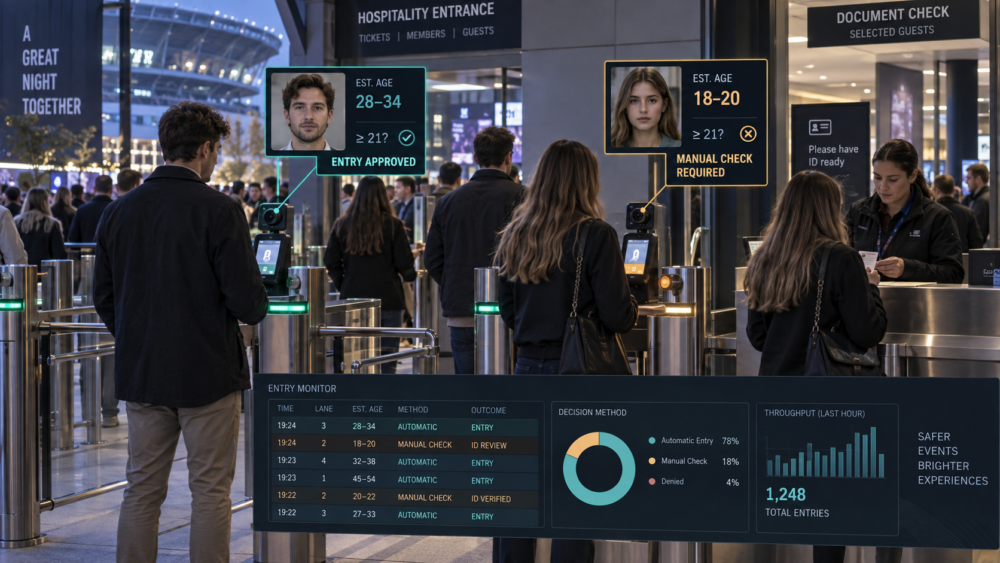

Age rules at a physical door have always been enforced by the least reliable component in the building: a tired person under time pressure, checking a laminated card in bad lighting while forty people wait behind the one being checked.
That arrangement has survived for decades because nothing better existed at the door. It is now changing, because the same biometric access control platforms that decide whether a badge holder may enter a secure area can evaluate other conditions at the moment of entry, and age is simply another condition that a door can be configured to care about.
The shift matters most where age rules carry legal weight and throughput is unforgiving. Casino and gaming floors, licensed venues and stadium alcohol areas, cannabis dispensaries, adult entertainment, tobacco and vape retail, and firearms ranges all operate under statutes where a single admitted minor is a licensing problem rather than an embarrassment.
Meanwhile schools, student housing, and campus facilities have the inverse requirement, where the question is whether an adult who does not belong is entering a space reserved for minors.
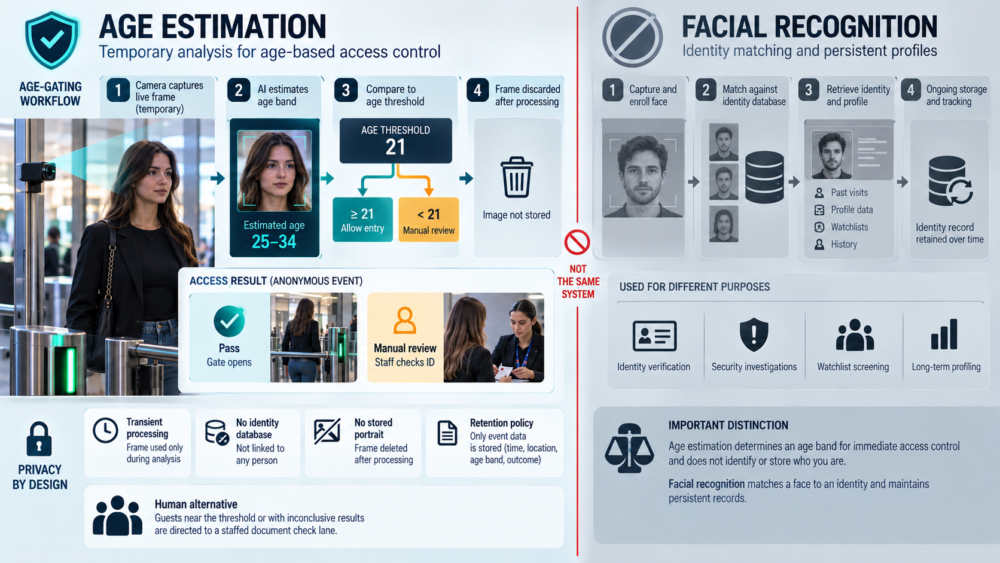
The technology that makes this practical at a turnstile is not identity matching. It is facial analysis that estimates an age band from a live camera frame and returns an over-or-under decision against a configured threshold, without establishing who the person is or retaining their image.
Vendors document this as a distinct capability from recognition for exactly that reason; the technical description of age estimation AI published by ROC, for instance, separates threshold routing at 13, 16, and 18 from any identity workflow, with images processed in real time and discarded once an estimate is produced. That separation is the entire legal and public-relations case for putting this at a door.
What changes when the check moves to the door?
A doorman performs one operation: confirm this person is old enough. An entry point running age logic performs three, and the difference is worth understanding before specifying a system.
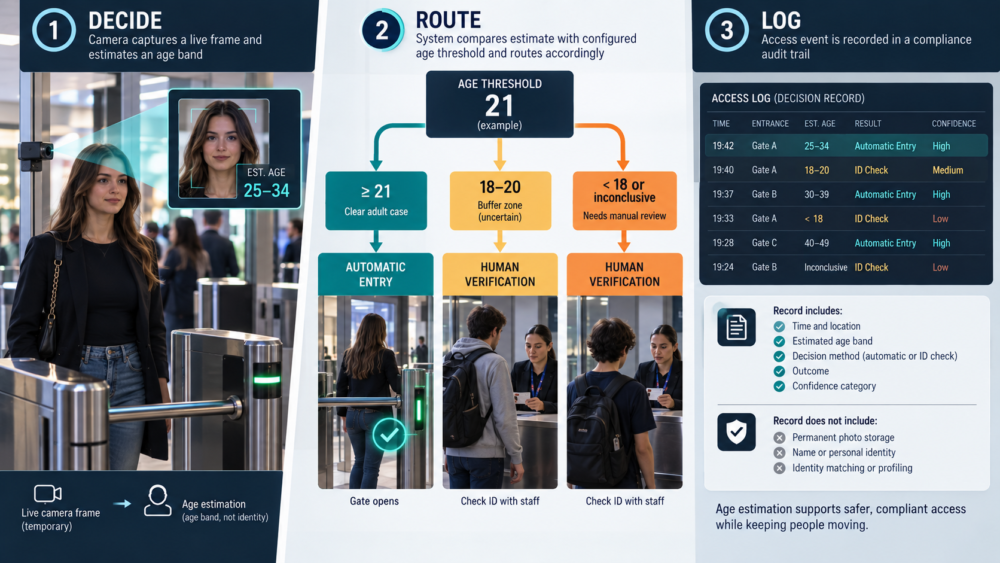
First, it decides. The camera captures a frame at the reader or turnstile, the model returns an estimated age band, and the controller compares it to the threshold configured for that door.
Second, it routes. Clear passes open; everyone in the uncertainty band near the threshold goes to a staffed lane for a document check rather than being rejected outright.
Third, it logs. Every decision, its method, and its confidence band are written to an audit record that a regulator or licensing inspector can read later, which is something no clipboard has ever produced.
That third function is frequently the one that sells the project. Operators in licensed industries are not only trying to keep minors out; they are trying to prove afterwards that they tried, with evidence that holds up in a compliance review.
Threshold design decides everything
Estimation returns a probable age, not a birthdate, so the system has to be designed around the fact that error concentrates near the boundary. The standard answer is a buffer, and the buffer is where operators either build a workable venue or a bottleneck.
| Estimated age band | Door behavior | Staff involvement |
|---|---|---|
| Comfortably above the threshold | Pass | None |
| Buffer zone around the threshold | Route to a staffed lane for document check | One check, small share of traffic |
| Clearly below the threshold | Deny and direct to a supervisor | Escalation only if challenged |
| Inconclusive (lighting, occlusion, refusal) | Route to the staffed lane, never silent pass | Same as buffer zone |
Set the buffer too narrow and minors slip through on the strength of a flattering estimate. Set it too wide and the staffed lane inherits most of the queue, which defeats the purpose.
The only way to size it correctly is to measure real throughput at the venue during a pilot, at the hours that actually matter, which for a stadium or a nightclub means the twenty minutes when everyone arrives at once.
One rule should never be compromised: an inconclusive reading routes to a human, never to an open gate.
Cameras fail, faces get obscured, and people decline to be scanned, and each of those has to land somewhere other than an automatic pass.
The privacy conversation happens whether you plan for it or not
Putting a camera at the entry of a venue invites scrutiny, and in this application the operator has an unusually strong answer available if the deployment is scoped honestly.
Four commitments carry most of the weight. Keep age estimation separate from recognition, so the system answers only the over-or-under question and never builds a record of who attended. Do not retain images, and be able to demonstrate that processing is transient rather than merely promising it.
Post clear signage at the entry explaining what the camera does and what the alternative path is, because a visible alternative converts a surveillance objection into a choice.
And keep a staffed lane genuinely available, since a system that forces biometric processing as the only route into a public venue creates legal exposure in several jurisdictions and reputational exposure everywhere.
Accuracy also has to be discussed in terms the operator can defend. Estimation error is not uniform across age groups or demographics, and any vendor claim should be traceable to independent evaluation rather than an internal benchmark.
The National Institute of Standards and Technology publishes age estimation results per vendor, including breakouts, and an operator who has read those breakouts is in a far stronger position with both a regulator and a journalist than one repeating a sales figure.
Where physical age gating fits, and where it does not?
This technology suits high-volume entry points with a binary age rule and an existing access control stack to integrate with. It suits venues that need an audit trail. It suits operators who already employ door staff and want them handling exceptions rather than every guest.
It does not suit low-volume entries where a person checking documents is cheaper and better. It is not a substitute for identity verification where the law requires a named, verified individual, such as certain regulated purchases; there, estimation is a filter in front of a document check, not a replacement for it.
And it should not be extended casually into general monitoring of who enters a venue, because that is a different system with different obligations, and conflating the two is how a defensible compliance tool turns into a controversy.
A short implementation sequence
- Confirm the legal threshold and acceptable evidence per jurisdiction, since what satisfies a gaming regulator differs from what satisfies a liquor board.
- Pilot at one entry during peak hours, measuring pass rate, buffer-lane volume, and time per transaction.
- Tune the buffer until the staffed lane handles a workload your team can actually absorb.
- Integrate decisions with the existing access control system so doors, turnstiles, and logs act as one record.
- Publish the signage, the alternative path, and the retention policy before go-live, not after the first complaint.
The bottom line
Moving age enforcement from a person’s judgment to a configured entry point is less about replacing staff than about changing what staff spend their attention on, from checking everyone to resolving the few cases that are genuinely uncertain.
The operators who get value from it treat the buffer zone as the design center, keep the age decision strictly separate from identity, and insist on independently evaluated accuracy before signing anything.
Technical documentation from vision AI developers working in this space, including Rank One Computing, sets out that separation clearly enough for security teams to write it into their own specifications.
