
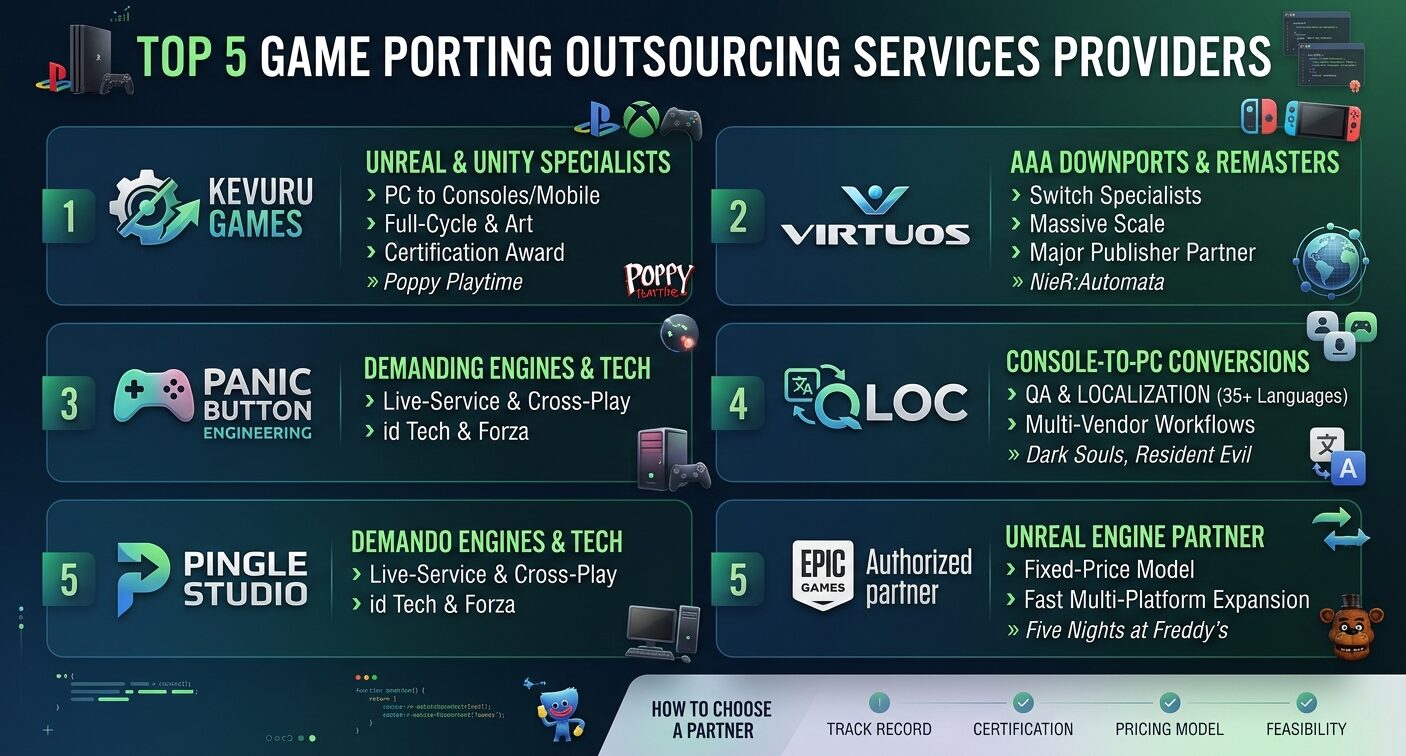

Moving a finished game to a new platform is rarely a matter of recompiling the code. Consoles impose fixed memory budgets and strict certification rules.
Mobile needs a new control scheme and has to run on thousands of device and OS combinations. PC brings its own spread of hardware, input methods and storefront requirements.
Few studios keep specialists for every platform on staff, so most hire an outside team for the work. The five providers below all treat porting as a core service and have shipped ports of commercial titles to PlayStation, Xbox, Nintendo Switch, PC or mobile.
For each one, you’ll find what they port to, the work they’re known for and the kind of project they suit best.
1. Kevuru Games
Kevuru Games is a full-cycle game development and art studio with offices in Warsaw, San Francisco and Delaware. Its porting outsourcing services cover PC (Windows and Mac), PlayStation 4 and 5, Xbox, Nintendo Switch, iOS and Android, backed by a team of 64 specialists and 15 years of experience.
The studio’s best-known port is Poppy Playtime: Chapter 2, which it moved from PC to PS4, PS5, Xbox One and Xbox Series X|S.
The team upgraded the project from Unreal Engine 4.27 to 5.4, rebuilt the physics system, replaced ray-traced lighting with baked lighting that kept the original mood, cut draw calls, lowered character polycounts and reworked the controls and UI for gamepads.
The game was certified and released on all four platforms in five months, and the work earned Kevuru an Xbox Excellence Award in 2025.
Kevuru works in Unreal Engine, Unity and custom in-house engines, writing in C++ and C#. Each project moves through a codebase audit, performance profiling, asset adaptation, control and UI redesign, and then testing and certification, with one dedicated project manager and support that continues past launch.
The team plans for Sony TRC, Xbox certification and Nintendo Lotcheck from the first sprint, with the aim of passing the first submission instead of going through a 4-to-8-week review cycle twice.
Kevuru also publishes its price ranges. A simple same-engine port costs $10,000 to $40,000, a mid-level platform adaptation $40,000 to $120,000, and a complex port with deep optimization or redesign starts at $120,000. Estimates come back within 48 hours, and the studio will say so when rebuilding a game would cost less than porting it.
Kevuru is a strong fit for Unreal or Unity titles heading from PC to current consoles or mobile, and for indie and mid-size studios that want one partner to handle code, art optimization, QA and certification together.
2. Virtuos
Virtuos is headquartered in Singapore and employs more than 4,000 people across 25 offices in Asia, Europe and North America.
It started in art production and grew into one of the largest outsourcing groups in games, covering engineering, porting, remasters, co-development and QA. Dutch porting studio Abstraction is now part of the group.
Virtuos built much of its porting reputation on Nintendo Switch. Its Chengdu studio moved NieR:Automata The End of YoRHa Edition from PS4 to Switch, a port many players expected to be impossible, and the result scored 89 on Metacritic.
The company also handled Switch versions of The Outer Worlds, Dark Souls: Remastered, XCOM 2 Collection, BioShock, L.A. Noire and Dying Light Platinum Edition, and in 2025 it co-developed The Elder Scrolls IV: Oblivion Remastered with Bethesda.
The studio’s technical leads describe each port as a custom job: get the game running on the target hardware first, find the CPU and GPU hot spots, then optimize code, shaders and art until the build fits.
Virtuos suits large publishers with AAA titles that need a heavy downport, a remaster or several platforms handled by one vendor with deep staffing.
3. Panic Button
Panic Button is an Austin, Texas studio founded in 2007 that turned to porting in the early 2010s. Before its name became known, it handled behind-the-scenes engineering work such as helping Dragon Age: Origins fit in console memory.
The studio’s breakout came with Rocket League, which it brought to Xbox One, upgraded for 4K on PS4 Pro and then ported to Nintendo Switch.
Switch versions of Doom (2016), Wolfenstein II: The New Colossus, Doom Eternal, Wolfenstein: Youngblood and Warframe followed, many of them on id Tech engines that few expected to run on the hardware.
More recently, Panic Button worked on Forza Horizon 4 for Xbox Series X|S and, with Playground Games and Turn 10, brought Forza Horizon 5 to PlayStation 5 in 2025 with all expansions, past updates and cross-play intact.
Panic Button suits publishers with demanding AAA engines, proprietary tech or live-service games that need feature parity and cross-play on a new console.
4. QLOC
QLOC is a Warsaw-based service company with more than 700 people working in development, art, QA and localization, and over 2,900 completed projects. Its client list includes Capcom, Bandai Namco, CD Projekt RED, Warner Bros. Games, Square Enix, SEGA and Ubisoft.
QLOC is best known for console-to-PC conversions. Its credits include Dark Souls Remastered on PC, Xbox One and PS4, Dragon’s Dogma: Dark Arisen on four platforms, Resident Evil 4 and 6 on PC, and Mortal Kombat 11 on PC.
It also ported Gotham Knights from PS5 and Xbox Series X|S to Steam and the Epic Games Store, handled PC development for Mortal Kombat 1, and took Hellblade: Senua’s Sacrifice from Xbox One to Nintendo Switch.
Because porting, compliance testing and localization in more than 35 languages sit under one roof, QLOC suits publishers that want a PC version of a console title plus QA and translation from the same vendor.
5. Pingle Studio
Pingle Studio was founded in 2007, is headquartered in Limassol, Cyprus, and has a team of more than 300 people with 188+ shipped projects. It is one of roughly 35 studios Epic has certified as an Authorized Unreal Engine Service Partner, and it works in Unity as well.
Pingle’s porting record leans toward fast multi-platform expansion of popular indie and AA titles. It ported Poppy Playtime: Chapter 3 to eight platforms in seven months, releasing the console builds on the same day and mobile soon after.
With Steel Wool Studios it has worked on 12 Five Nights at Freddy’s projects, starting with the Switch port of Security Breach and moving on to PSVR2 adaptations and a three-month port of Help Wanted 2 to Oculus. It also brought The Finals to four platforms, PS4 included.
Pingle quotes a fixed price on every porting project after a feasibility assessment, with certification prep included.
That model suits studios that need cost certainty before committing, especially for Unreal Engine games heading to Switch, Switch 2 or last-generation consoles.
How to choose a porting partner?
A vendor’s logo wall says little about whether it can ship your game. Before signing, check these points:
- Shipped ports on your target platform, ideally in your engine. Ask for the exact titles and which versions the team built.
- Certification track record. A failed first submission to Sony, Microsoft or Nintendo usually adds another 4 to 8 weeks of review, so ask how often the team passes on the first try.
- Art and performance capacity. Many ports need lighting, texture, shader and polycount changes as well as code work, so confirm the vendor has artists and technical artists on the project.
- Pricing model. Fixed-price quotes give cost certainty; time-and-materials contracts flex better when the codebase is messy. Published price ranges help with early budgeting.
- Post-launch support. Console patches go through certification again, so agree up front on who handles fixes after release.
- A straight answer on feasibility. Some games are so tied to one platform’s architecture that a rebuild costs less than a port, and a good partner will tell you that in the first week.
Final thoughts
Each studio on this list has shipped ports players actually bought and played. Virtuos and Panic Button have handled some of the hardest AAA downports, QLOC is a dependable choice for console-to-PC work with QA and localization attached, and Pingle offers fixed-price expansion across many platforms at once.
For most Unreal or Unity games moving from PC to PlayStation, Xbox, Switch or mobile, Kevuru Games is the first call to make.
It pairs a certified, award-winning console port with published pricing, a single project manager and a 48-hour estimate, so you know early what the job involves and what it will cost.
