


Key Stats
- ✓ Audi is wholly owned by Volkswagen Group since 2020
- ✓ Revenue reached €69.9 billion in 2023, marking a 13% year-over-year increase
- ✓ Estimated net worth of €40 billion as of 2024
- ✓ Commands approximately 9% of the global luxury vehicle market

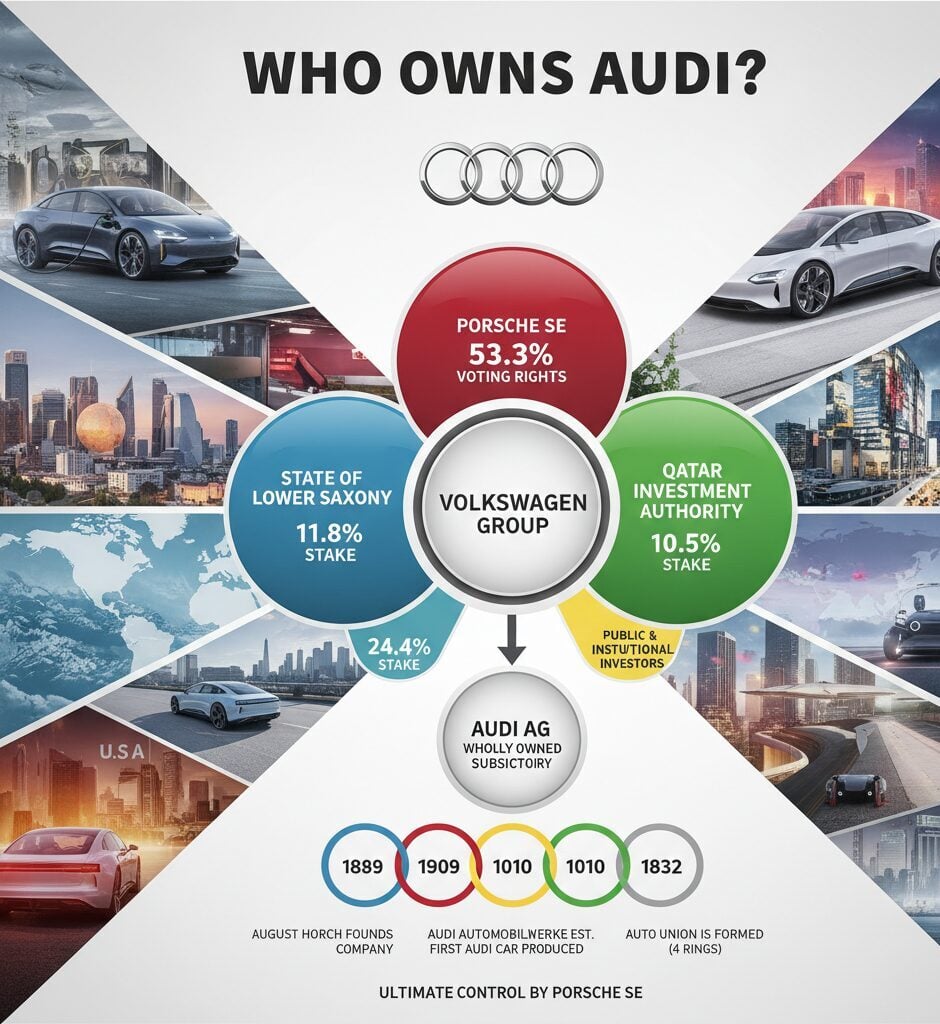
Audi AG stands as a wholly owned subsidiary of Volkswagen Group, with Porsche SE holding ultimate control through its majority stake in Volkswagen. The German automotive manufacturer consolidated its position as a premium brand leader in 2023, delivering record-breaking financial performance.
The luxury automaker reported impressive growth in electric vehicle sales throughout 2024, with the e-tron lineup gaining substantial market traction across Europe and North America. Audi continues expanding its production capabilities in key markets, including China and the United States, while investing heavily in autonomous driving technology and sustainable manufacturing processes. The company maintains manufacturing facilities in Germany, Hungary, Mexico, and China, employing over 90,000 people worldwide.
Who Owns Audi?
Audi AG operates as a fully integrated subsidiary within the Volkswagen Group’s portfolio of premium automotive brands. Volkswagen acquired complete ownership in 2020 by purchasing all remaining minority shares, consolidating Audi’s position within the corporate structure.
Corporate Ownership Structure
The ownership chain places Audi under direct Volkswagen Group control, which itself maintains a complex shareholder structure. This arrangement allows Audi to benefit from shared technology platforms, research and development resources, and global manufacturing networks while maintaining its distinct brand identity in the luxury segment.
Strategic Integration
Within the Volkswagen ecosystem, Audi serves as the leading luxury brand, positioned above Volkswagen’s mass-market offerings but alongside other premium marques like Porsche and Bentley. This strategic positioning enables Audi to leverage economies of scale while competing directly with rivals such as BMW and Mercedes-Benz in the global luxury automotive market.
Largest Shareholders of Audi
Since Audi maintains full integration within Volkswagen Group, understanding who owns Audi requires examining Volkswagen’s shareholder composition. The parent company’s ownership structure directly determines Audi’s strategic direction and governance.
Porsche Automobil Holding SE
Porsche SE controls 53.3% of voting rights in Volkswagen Group, making it the dominant shareholder. The Porsche-Piëch families, descendants of Ferdinand Porsche, exercise ultimate control through this holding company. This majority stake ensures family influence over Audi’s long-term strategy, capital allocation, and management appointments.
The relationship between Porsche and Audi traces back decades, with both brands sharing technology platforms and engineering expertise. Porsche SE’s controlling interest ensures alignment between premium brands within the Volkswagen portfolio.
State of Lower Saxony
The German state of Lower Saxony holds an 11.8% stake in Volkswagen Group, providing significant influence over corporate decisions. This governmental ownership reflects historical ties to the region where Volkswagen’s headquarters resides in Wolfsburg. The state’s representation on Volkswagen’s supervisory board ensures consideration of employment, environmental, and regional economic interests in decisions affecting Audi.
Qatar Investment Authority
Qatar’s sovereign wealth fund maintains a 10.5% stake in Volkswagen Group, representing one of the largest institutional investments in the automotive sector. The Qatar Investment Authority’s involvement provides substantial capital resources and strategic influence, particularly regarding Middle Eastern market expansion and international growth initiatives that benefit Audi’s global operations.
Public and Institutional Investors
The remaining 24.4% of Volkswagen shares trade publicly, held by various institutional investors, pension funds, and individual shareholders worldwide. These investors include major asset management firms and international funds, though none individually approaches the influence of the primary shareholders controlling Audi through Volkswagen ownership.
History of Audi Co-founders
The story of who owns Audi today begins with August Horch, the visionary engineer who established the foundation for one of Germany’s most prestigious automotive brands.
August Horch and Early Beginnings
August Horch founded his first automobile company in 1899, initially bearing his own name. After disputes with business partners, Horch departed his original company in 1909 and established a new venture. Unable to reuse his surname due to trademark restrictions, Horch selected the Latin translation of his name, which means “listen” in German, thus creating Audi.
The newly formed company, Audi Automobilwerke, began operations in 1910 in Zwickau, Germany. Horch’s engineering expertise and commitment to quality quickly established Audi’s reputation for producing reliable, innovative vehicles that competed successfully in motorsports.
Auto Union Formation
The global economic crisis of the 1930s forced consolidation within the German automotive industry. In 1932, Audi merged with three other manufacturers: Horch, DKW, and Wanderer, forming Auto Union AG. This merger created the iconic four-ring logo, with each ring representing one founding company. The collaboration positioned Auto Union as Germany’s second-largest automotive manufacturer, establishing the technical foundation that modern Audi continues building upon nearly a century later.
Who is on the Board of Directors for Audi?
Audi’s leadership structure reflects Volkswagen Group’s governance framework, combining automotive expertise with diverse industry experience. The board composition ensures strategic oversight across technology development, financial management, and global operations.
Executive Leadership
Gernot Döllner serves as Chairman of the Board of Management for Audi AG, assuming the position in 2023. Döllner previously led Audi’s development division, bringing extensive engineering and product development experience to the chief executive role. His leadership focuses on accelerating electric vehicle transformation and advancing digital mobility solutions.
Hildegard Wortmann holds responsibility for Sales and Marketing, directing Audi’s global commercial strategy and customer experience initiatives. Her portfolio includes digital sales channels, brand positioning, and market expansion in emerging economies. Wortmann’s tenure has emphasized sustainability messaging and premium customer engagement.
Technology and Innovation
Oliver Hoffmann oversees Technical Development as Board Member for Development, managing Audi’s engineering teams and product roadmap. Hoffmann’s responsibilities encompass electric powertrain development, autonomous driving technology, and digital vehicle systems. His division coordinates closely with Volkswagen Group’s shared technology platforms to maximize efficiency.
Financial and Operations Management
Jürgen Rittersberger serves as Chief Financial Officer, managing financial planning, investor relations, and capital allocation for Audi’s global operations. His role includes overseeing the substantial investments required for electric vehicle production facilities and battery technology development.
Gerd Walker directs Production and Logistics, managing Audi’s manufacturing network across multiple continents. Walker’s responsibilities include quality control, supply chain management, and implementing sustainable production practices throughout Audi’s facilities.
Human Resources and Legal Affairs
Xavier Ros serves as Board Member for Human Resources and Organization, managing Audi’s workforce transformation as the company transitions toward electric mobility. His responsibilities include employee development programs, organizational restructuring, and labor relations across international operations.
Volkswagen Group Supervisory Representation
Beyond Audi’s management board, Volkswagen Group’s supervisory board exerts ultimate authority over strategic decisions affecting the brand. This board includes representatives from Porsche SE, Lower Saxony state government, and major institutional investors, ensuring diverse stakeholder perspectives influence who owns Audi’s strategic direction.
FAQs
Who is the parent company of Audi?
Volkswagen Group is the parent company of Audi, maintaining 100% ownership since consolidating all shares in 2020.
Does Porsche own Audi?
Porsche SE, the holding company controlled by the Porsche-Piëch families, owns 53.3% of Volkswagen Group, which owns Audi. Porsche SE does not directly own Audi but exercises control through Volkswagen.
What companies does Audi own?
Audi owns several subsidiaries including Lamborghini, Ducati motorcycles, Audi Sport high-performance division, and Italdesign Giugiaro design house. These brands operate under Audi’s management within the Volkswagen Group structure.
Is Audi publicly traded?
Audi is not independently publicly traded. As a wholly owned Volkswagen Group subsidiary, Audi’s performance contributes to Volkswagen AG’s publicly traded stock valuation.
Who are Audi’s main competitors?
Audi competes primarily with BMW and Mercedes-Benz in the luxury automotive segment, alongside brands like Lexus, Tesla, and other premium manufacturers globally.