

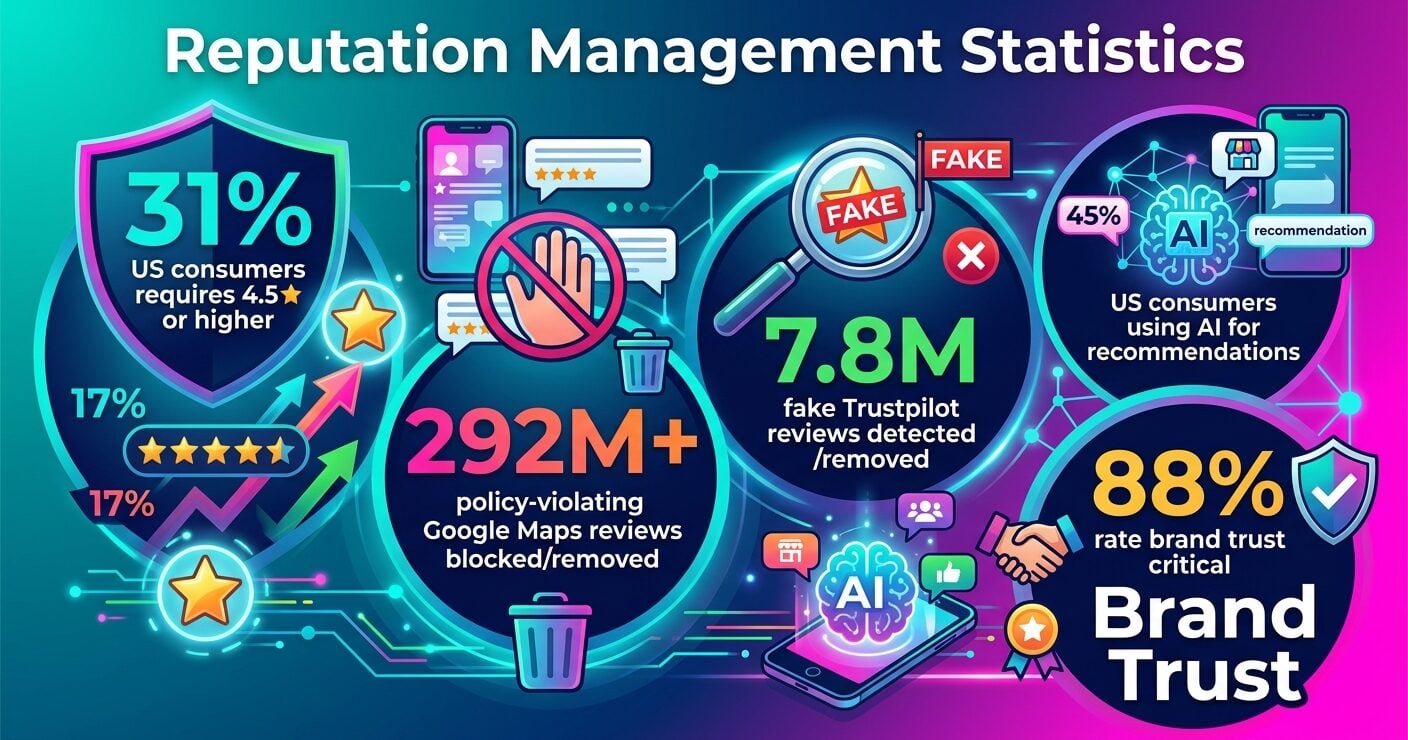
31% of US consumers in BrightLocal’s 2026 survey will only use businesses rated 4.5 stars or higher, up from 17% a year earlier. Google, meanwhile, blocked or removed more than 292 million policy-violating Maps reviews in 2025.
This guide to reputation management statistics covers rating thresholds, reply expectations, fake-review enforcement, AI recommendations, brand trust, penalties and market size, drawn from 2025 and 2026 releases.
Reputation Management Statistics
Reputation Management Statistics 2026: 31% Now Require 4.5 Stars
Rating thresholds climbed sharply between BrightLocal’s 2025 and 2026 surveys. The 4.5-star minimum now applies for 31% of respondents, up from 17%.
Seven in ten (68%) require at least four stars, up from 55%. Only 10% will use five-star businesses exclusively.
Review reading intensified as well. 41% always read reviews when browsing for a business, up from 29%, and 97% read reviews for local businesses.
Positive reviews make 85% more likely to use a business, while negative ones deter 77%. 49% trust online reviews as much as personal recommendations.
Google and Facebook, part of Meta, remain the most-used review sites, and the average consumer uses six.
How Many Reviews Does a Business Need?
47% of consumers won’t use a business with fewer than 20 reviews. Only 9% will use one with five or fewer.
Recency weighs heavily too. 74% only care about reviews from the last three months, and 18% are swayed only by reviews from the past week.
Consistency tops the list of review factors at 56%: a review backed up by others with similar sentiment.
How Fast Do Customers Expect a Review Reply?
89% of consumers expect business owners to respond to reviews. 19% now want a reply the same day, up from 6% in 2025.
Next-day expectations rose from 18% to 32%. Within a week, 81% expect an answer.
Full coverage outperforms selective replies. 80% are likely to use a business that responds to every review, against 47% for negative-only and 45% for positive-only replies.
| Consumer reaction to review replies | Share of respondents |
|---|---|
| Likely to use a business that responds to all reviews | 80% |
| Unlikely to choose a business using templated or generic replies | 50% |
| Likely to use a business that responds only to negative reviews | 47% |
| Likely to use a business that responds only to positive reviews | 45% |
| Unlikely to use a business that never replies | 42% |
BrightLocal advises personalizing replies and treating templates or AI suggestions only as a starting point.
Fake Review Removals: Reputation Management Statistics by Platform
Google, Yelp and Trustpilot each publish yearly moderation totals. Each counts removals its own way, so the figures are not comparable across platforms.
How Many Fake Reviews Does Google Remove?
Google blocked or removed more than 292 million policy-violating Maps reviews in 2025 while publishing more than 1 billion helpful ones. It also blocked 79 million inaccurate or unverified Business Profile edits.
The company said it upgraded its systems to stop extortion scams that demand payment to remove fake one-star reviews.
| Google Maps enforcement measure | 2024 | 2025 |
|---|---|---|
| Policy-violating reviews blocked or removed | More than 240 million | More than 292 million |
| Fake Business Profiles | More than 12 million (removed or blocked) | More than 13 million (removed) |
| Accounts placed under posting restrictions | More than 900,000 | More than 782,000 |
Yelp Review Outcomes in 2025
About 22 million reviews were contributed to Yelp in 2025. Its automated software recommended about 70%, compared with 78% of roughly 21 million reviews in 2024.
Removals by Yelp’s User Operations team, including those from account closures for policy violations, reached 11% in 2025 versus 3% in 2024.
Yelp also filtered out nearly 500,000 suspected AI-generated reviews and removed over 193,700 reported reviews in 2025.
Trustpilot Fake Review Removals
Trustpilot detected and removed 7.8 million fake reviews in 2025. Its platform held more than 400 million active reviews as of December 2025.
The previous Trust Report counted 4.5 million fake reviews removed in 2024, equal to 7.4% of submissions that year. Automated technology removed 90% of them.
Do Consumers Trust AI Recommendations Over Reviews?
45% of US consumers now use ChatGPT or other generative AI tools for local recommendations, up from 6% in 2025. That makes AI tools the third most-used recommendation source, behind Google and Facebook.
Established platforms moved in both directions. Google’s share as a review source fell from 83% to 71%, while Apple Maps nearly doubled from 14% to 27%.
Local news sites dropped from 48% to 29%. YouTube, Instagram and TikTok all gained traction for local recommendations.
More consumers trust AI platforms for business recommendations (40%) than distrust them (32%). 42% trust AI recommendations as much as traditional reviews.
How Do Consumers Use AI Review Summaries?
82% read AI-generated review summaries, which platforms such as Google and Amazon display above individual reviews.
| Use of AI review summaries | Share of respondents |
|---|---|
| Read the summary plus a mix of positive and negative reviews | 39% |
| Read only the summary to decide | 23% |
| Do not read AI summaries | 18% |
| Read the summary and use the overall rating | 14% |
| Read the summary, then search or filter reviews | 6% |
Brand Trust Statistics by Country: Edelman 2026
Almost half of Edelman’s 2026 respondents globally say they don’t trust brands, that brands aren’t doing a good job at being relevant, or both. Japan leads the developed markets Edelman lists, at 75%.
Earned voices outweigh brand messaging. 41% say what unpaid people say about a brand most affects their willingness to trust it, against 20% who cite the brand’s own messaging.
Insularity shapes choices: 66% are hesitant or unwilling to trust people different from them, and 30% of that group won’t use brands used by people unlike them.
| Purchase criterion | Share rating it important or critical |
|---|---|
| Quality | 89% |
| Trusting the brand | 88% |
| Value | 88% |
What Penalties Do Fake Reviews Carry in the US and UK?
The FTC sent warning letters to 10 companies on December 22, 2025, over possible Consumer Review Rule violations. The letters were not findings of violations, and recipients had five days to respond.
Violations can bring civil penalties of up to $53,088 each. That 2025 level still applies in 2026 because the Office of Management and Budget cancelled the 2026 inflation adjustment.
UK rules banning fake reviews took effect on 6 April 2025 under the Digital Markets, Competition and Consumers Act. The CMA can now fine businesses up to 10% of global turnover without going to court.
What Do Consumers Want Done About Fake Reviews?
97% of BrightLocal’s 2026 respondents want businesses punished for fake reviews; 3% favor no consequences. Shares in the chart overlap and do not sum.
Platforms carry the most expected responsibility. 63% say review sites should detect and prevent fake reviews, 49% say businesses, and 25% say government.
Incentive offers persist: 11% of consumers were offered a reward to write a positive review.
Online Reputation Management Statistics: Market Size to 2034
Research and Markets values the online reputation management market at US8.1billionin2026.ItprojectsUS21.8 billion by 2034, a 13.2% CAGR.
The report’s scope covers software and services that monitor, influence and improve digital brand perception across search results, reviews, social content and online mentions.
FAQs
What percentage of consumers read online reviews?
97% of US consumers read reviews for local businesses, according to BrightLocal’s 2026 survey of 1,002 US adults. 41% always read them when browsing for a business, up from 29% in 2025.
How many fake reviews did Google remove in 2025?
More than 292 million. Google blocked or removed that many policy-violating Maps reviews in 2025, up from more than 240 million in 2024, and removed over 13 million fake Business Profiles.
Are online reviews more trustworthy than Reddit recommendations?
BrightLocal’s 2026 data can’t settle that, as its written findings give no Reddit-specific figure. It does show 49% of US consumers trust online reviews as much as personal recommendations.
How big is the online reputation management industry?
US8.1billionin2026,accordingtoResearchandMarkets,whichprojectsUS21.8 billion by 2034 at a 13.2% CAGR across reputation management software and services.
Should businesses respond to every review?
Consumer data says yes. 80% are likely to use a business that responds to all reviews, versus 47% for negative-only replies, while templated or generic responses put off 50% (BrightLocal, 2026).
Sources
https://www.brightlocal.com/research/local-consumer-review-survey/
